I think the Hirshorn is my favorite Smithsonian museum. It has taken me some time but I have really grown to appreciate conceptual art. I think what most people don't understand about conceptual art is that, well, it's conceptual; that one needs to understand, or at least know, what the concept is to appreciate it. The design is not in the aesthetic like "normal" or picturesque art.
Going to the Friday gallery talks has really helped me to understand this. For example, this past week's talk. When you first look at the singular work, it is slightly underwhelming, but has an overal pleasant calming effect. But when you look closer you see that the "ripples" are made of numbers, which is intriguing, and made me appreciate the effort and time that it must have taken to create the work. But only after having learned the context of the work (that it is part of a life long series), and the nature of the artist does the artwork truly come alive. I like this aspect of conceptual art. The more you learn about it and the more you discuss it the more it comes alive. I think this is why I love art education. Helping people to ask questions and understand why works are as exciting as they are is really exciting for me.
Another work I found really inspiring from the art education context was the "Condensation Box". It just allowed me to imagine showing and discussing with a group of young students, how it was built, how the condensation stays in there, etc. Then being able to take those ideas and apply them to a science class. It helps me to see that art can be collaborative in many, many ways, and the more we collaborate, on specific works, in our own education, and while educating others the more rich each art experience will be.
11/3/08

putting all the pieces together
Well, our group's project is coming up (5 days to be exact) and it seems like it is pretty much coming all together. Having been in charge of the music portion of the collaboration I hope that the work I have put together meets with the expectations of the group. Though I suppose if it isn't- we've still got 5 days to hatch it out.
The art we saw at the Hirschorn Museum on Friday was pretty inspirational for me. I don't know what it was about the current show that was so eye-opening for me. Perhaps it was the full use of the room, scale, simple geometry? I'm not quite sure, but whatever it was certainly had me creating all weekend. After a pretty expensive trip to plaza I spent the better part of Saturday working on art projects that have been slipping through the cracks for the past few months. It felt good to get some new things out- well, started at least. Now they are staring me in the face so I have to complete them (not just sketches in pads and notebooks). Hopefully I'll get some done in time to bring to class for some input.
The art we saw at the Hirschorn Museum on Friday was pretty inspirational for me. I don't know what it was about the current show that was so eye-opening for me. Perhaps it was the full use of the room, scale, simple geometry? I'm not quite sure, but whatever it was certainly had me creating all weekend. After a pretty expensive trip to plaza I spent the better part of Saturday working on art projects that have been slipping through the cracks for the past few months. It felt good to get some new things out- well, started at least. Now they are staring me in the face so I have to complete them (not just sketches in pads and notebooks). Hopefully I'll get some done in time to bring to class for some input.
10/30/08
Participation (Documents of Contemporary Art)
I got an email from Amazon.com recently with computer-generated book recommendations. Coincidentally, the first recommended book was Participation (Documents of Contemporary Art) by Claire Bishop.

I read up about the book on Amazon's website (click image ^ to get link). From what I can tell, this book examines the evolution of collaborative art. It even discusses some of the theorists and artists we're already talked about in this class. These people include Allan Kaprow, Guy Debord, and Jacques Rancière.
I know we're already read about those people, but it seems like this book might be good to summarize their work and offer it within the context of the art world. Anyone who is really interested in collaborative art making and theory should check it out.
Product description (from Amazon.com):
The desire to move viewers out of the role of passive observers and into the role of producers is one of the hallmarks of twentieth-century art. This tendency can be found in practices and projects ranging from El Lissitzky's exhibition designs to Allan Kaprow's happenings, from minimalist objects to installation art. More recently, this kind of participatory art has gone so far as to encourage and produce new social relationships. Guy Debord's celebrated argument that capitalism fragments the social bond has become the premise for much relational art seeking to challenge and provide alternatives to the discontents of contemporary life. This publication collects texts that place this artistic development in historical and theoretical context.
Participation begins with writings that provide a theoretical framework for relational art, with essays by Umberto Eco, Bertolt Brecht, Roland Barthes, Peter Bürger, Jen-Luc Nancy, Edoaurd Glissant, and Félix Guattari, as well as the first translation into English of Jacques Rancière's influential "Problems and Transformations in Critical Art." The book also includes central writings by such artists as Lygia Clark and Hélio Oiticica, Joseph Beuys, Augusto Boal, Felix Gonzalez-Torres, Thomas Hirschhorn, and Rirkrit Tiravanija. And it features recent critical and curatorial debates, with discussions by Lars Bang Larsen, Nicolas Bourriaud, Hal Foster, and Hans-Ulrich Obrist.
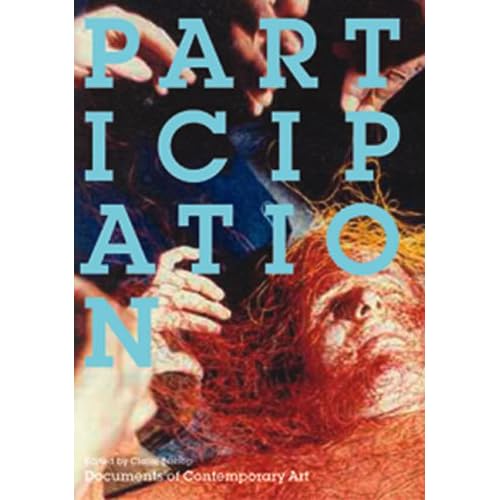
I read up about the book on Amazon's website (click image ^ to get link). From what I can tell, this book examines the evolution of collaborative art. It even discusses some of the theorists and artists we're already talked about in this class. These people include Allan Kaprow, Guy Debord, and Jacques Rancière.
I know we're already read about those people, but it seems like this book might be good to summarize their work and offer it within the context of the art world. Anyone who is really interested in collaborative art making and theory should check it out.
Product description (from Amazon.com):
The desire to move viewers out of the role of passive observers and into the role of producers is one of the hallmarks of twentieth-century art. This tendency can be found in practices and projects ranging from El Lissitzky's exhibition designs to Allan Kaprow's happenings, from minimalist objects to installation art. More recently, this kind of participatory art has gone so far as to encourage and produce new social relationships. Guy Debord's celebrated argument that capitalism fragments the social bond has become the premise for much relational art seeking to challenge and provide alternatives to the discontents of contemporary life. This publication collects texts that place this artistic development in historical and theoretical context.
Participation begins with writings that provide a theoretical framework for relational art, with essays by Umberto Eco, Bertolt Brecht, Roland Barthes, Peter Bürger, Jen-Luc Nancy, Edoaurd Glissant, and Félix Guattari, as well as the first translation into English of Jacques Rancière's influential "Problems and Transformations in Critical Art." The book also includes central writings by such artists as Lygia Clark and Hélio Oiticica, Joseph Beuys, Augusto Boal, Felix Gonzalez-Torres, Thomas Hirschhorn, and Rirkrit Tiravanija. And it features recent critical and curatorial debates, with discussions by Lars Bang Larsen, Nicolas Bourriaud, Hal Foster, and Hans-Ulrich Obrist.
Subscribe to:
Posts (Atom)